Salmon cuts.
USDA FSIS and FDA both put fish at 145 F, or until the flesh is opaque and separates easily with a fork. Salmon cooks fast, does not stall, and is the one Pit Log animal where the delicate flavour argues for the mildest woods.
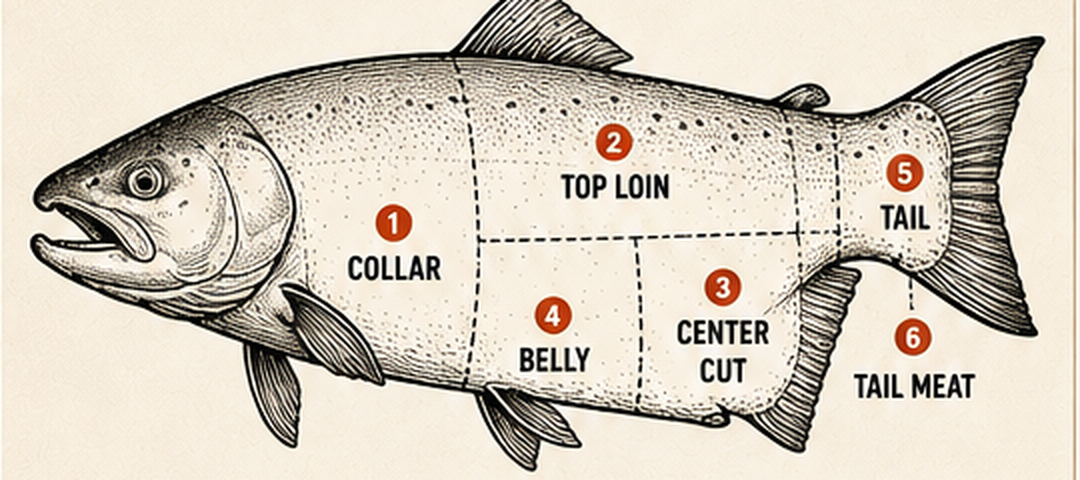
Tap a region on the diagram, or use the list below.
Six regions matching the master. These are fishmonger and restaurant trade terms for portions of a side of salmon, not a regulated primal scheme; no federal or industry cut chart naming them was located. The Alaska Seafood Marketing Institute trim guide governs fillet trim levels, not these portions. Region records carry NEEDS_SOURCE for naming and SOURCED for safety.
Pick a region
- 01
Collar
The fatty piece behind the head and gills. Rich, tender, a fishmonger's secret.
Tenderness 4/5. Richness 5/5. Grill.
- 02
Top loin (back)
The thick back strap above the spine. Leanest, most uniform thickness; the premium grilling portion.
Tenderness 4/5. Richness 3/5. Grill.
- 03
Center cut
The middle of the fillet. The best balance of fat and firmness; the all-purpose portion and the classic cedar-plank piece.
Tenderness 4/5. Richness 4/5. Grill.
- 04
Belly
The thin, fat-rich strip along the underside. Buttery; ideal for smoking and grilling; stays moist.
Tenderness 5/5. Richness 5/5. Smoke.
- 05
Tail
The tapering rear of the fillet. Leaner, firmer, thinner; fast cooks, poaching, baking.
Tenderness 3/5. Richness 2/5. Bake.
- 06
Second cut (tail meat)
Darker, stronger-flavoured meat toward the tail and along the lateral line. Smoke it, or use it in chowder and cakes.
Tenderness 3/5. Richness 3/5. Smoke.
Safe first. Then done.
145 F (62.8 C)
Fish and shellfish. Thermometer in the thickest part of the fillet; or the flesh is opaque and separates easily with a fork. This is a food safety floor, not a preference. Where any other number on this page is lower, this one governs.
Source: USDA Food Safety and Inspection Service, Safe Minimum Internal Temperature Chart, page updated 2025-04-14, read 2026-09-02.
salmon convention
Fillets and portions, restaurant convention. Culinary preference, barbecue convention.
| Doneness | Internal temp | Vs. USDA 145 F |
|---|---|---|
| Rare | 120 to 125 F | Below the minimum. Preference, not safety. |
| Medium rare | 125 to 130 F | Below the minimum. Preference, not safety. |
| Medium | 130 to 135 F | Below the minimum. Preference, not safety. |
| Medium well | 135 to 145 F | Below the minimum. Preference, not safety. |
| Well done (USDA minimum) | 145+ F | At or above the minimum. |
Carryover: Salmon carries over 5 to 10 F after a short rest; a fillet pulled at 140 F commonly reads 145 F at the table, but only the reading counts.
Every salmon figure below 145 F is a culinary preference that falls below the USDA FSIS and FDA safe minimum of 145 F. Where the two differ, the federal minimum governs.
Collagen cuts do not use a doneness scale. They cook to a tenderness window, shown on each cut page and on the salmon temperature page.