Goat primal cuts.
Goat is red meat, very lean, and cut like lamb. FSIS notes a goat carcass rarely has enough fat to protect it from drying, which is why gentle heat and moisture matter more than with any other animal here.
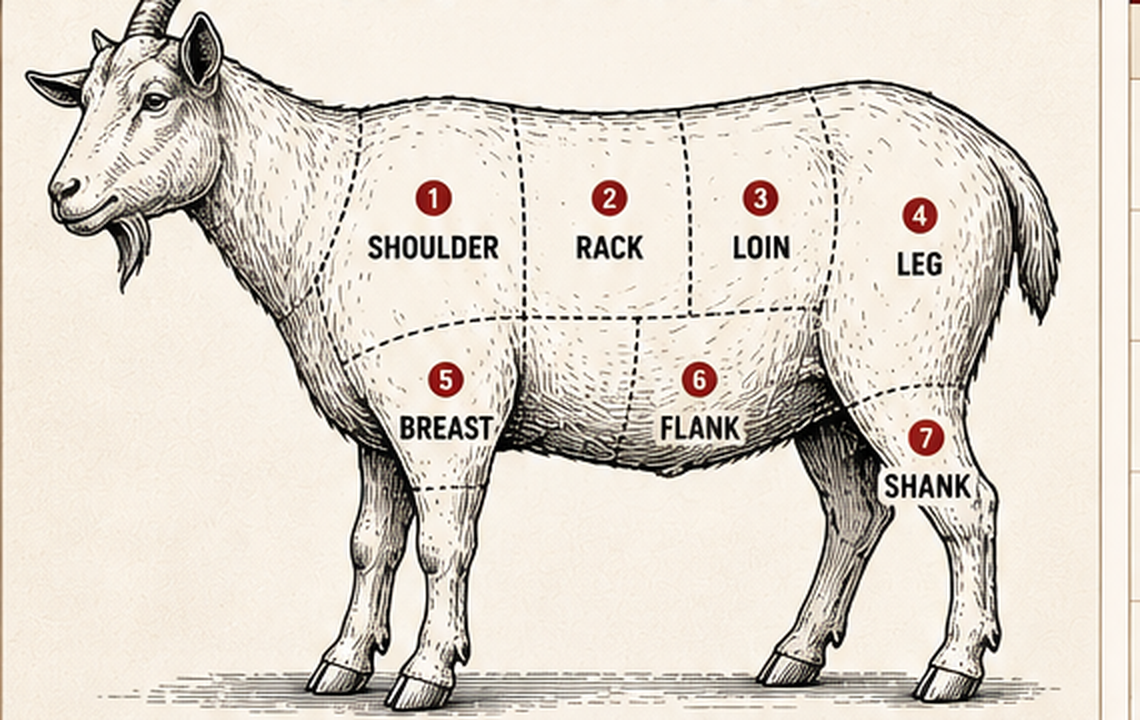
Tap a region on the diagram, or use the list below.
Same seven regions as lamb. USDA FSIS: 'Retail cuts of goat are similar to those for lamb or mutton.' No goat-specific industry cut chart was located; the lamb scheme is used with that provenance stated.
Pick a region
- 01
Shoulder
The most flavourful goat cut and the best candidate for low and slow. Lean, so it wants a wrap and a gentle pit.
Tenderness 2/5. Richness 3/5. Smoke then wrap.
- 02
Rack
Small, tender, quick. Kid rack cooks like lamb rack (FSIS).
Tenderness 5/5. Richness 3/5. Grill.
- 03
Loin
Lean and tender. Loin chops for the grill.
Tenderness 5/5. Richness 2/5. Grill.
- 04
Leg
Lean, rich in flavour. Roast it, or smoke it low and slice; braise it if it is from an older animal.
Tenderness 3/5. Richness 2/5. Roast.
- 05
Breast
Ribs and breast. The most connective tissue and the most of what little fat goat has. Stew, braise, or smoke low with a wrap.
Tenderness 2/5. Richness 3/5. Braise.
- 06
Flank
Thin and lean. Marinate, grill hot, slice thin, or grind.
Tenderness 2/5. Richness 2/5. Grill.
- 07
Shank
Tough and delicious after a long braise. Osso buco, birria, curry.
Tenderness 1/5. Richness 3/5. Braise.
Safe first. Then done.
145 F (62.8 C), then rest at least 3 minutes before carving or consuming
Steaks, chops and roasts (whole muscle). Food thermometer in the thickest part, away from bone, fat and gristle, read before removing from the heat source. This is a food safety floor, not a preference. Where any other number on this page is lower, this one governs.
Source: USDA Food Safety and Inspection Service, Safe Minimum Internal Temperature Chart, page updated 2025-04-14, read 2026-09-02.
160 F (71.1 C)
Ground meat, burgers, sausage mixtures, meat loaf, and organ or variety meats. Food thermometer through the side of a patty to the centre. This is a food safety floor, not a preference. Where any other number on this page is lower, this one governs.
Source: USDA Food Safety and Inspection Service, Safe Minimum Internal Temperature Chart, page updated 2025-04-14, read 2026-09-02.
lamb industry
Chops, rack, leg and roasts. Pull temperature and final temperature after rest. Culinary preference, as published by the industry body cited below.
| Doneness | Pull at | Internal temp | Vs. USDA 145 F |
|---|---|---|---|
| Medium rare | 135 F | 145 F, rest 3 minutes | At or above the minimum. |
| Medium | 150 F | 160 F | At or above the minimum. |
| Well | 160 F | 170 F | At or above the minimum. |
Carryover: American Lamb Board: pull 10 F below the target because the internal temperature keeps rising.
lamb goat convention
Chops and rack, restaurant convention, pull temperatures. Culinary preference, barbecue convention.
| Doneness | Internal temp | Vs. USDA 145 F |
|---|---|---|
| Rare | 125 to 130 F | Below the minimum. Preference, not safety. |
| Medium rare | 130 to 135 F | Below the minimum. Preference, not safety. |
| Medium | 135 to 145 F | Below the minimum. Preference, not safety. |
| Medium well | 145 to 155 F | At or above the minimum. |
| Well done | 160+ F | At or above the minimum. |
Carryover: 5 to 10 F on a rack or chop.
Rare, medium-rare and medium figures are culinary preference ranges that fall below the USDA FSIS safe minimum of 145 F with a 3 minute rest. USDA does not consider them safe. Where the two differ, the USDA minimum governs.
Collagen cuts do not use a doneness scale. They cook to a tenderness window, shown on each cut page and on the goat temperature page.