Beef primal cuts.
Meat from full-grown cattle about two years old. The tough, hard-working primals (chuck, brisket, round, shank) want low and slow; the middle meats (rib, short loin, sirloin) want dry heat.
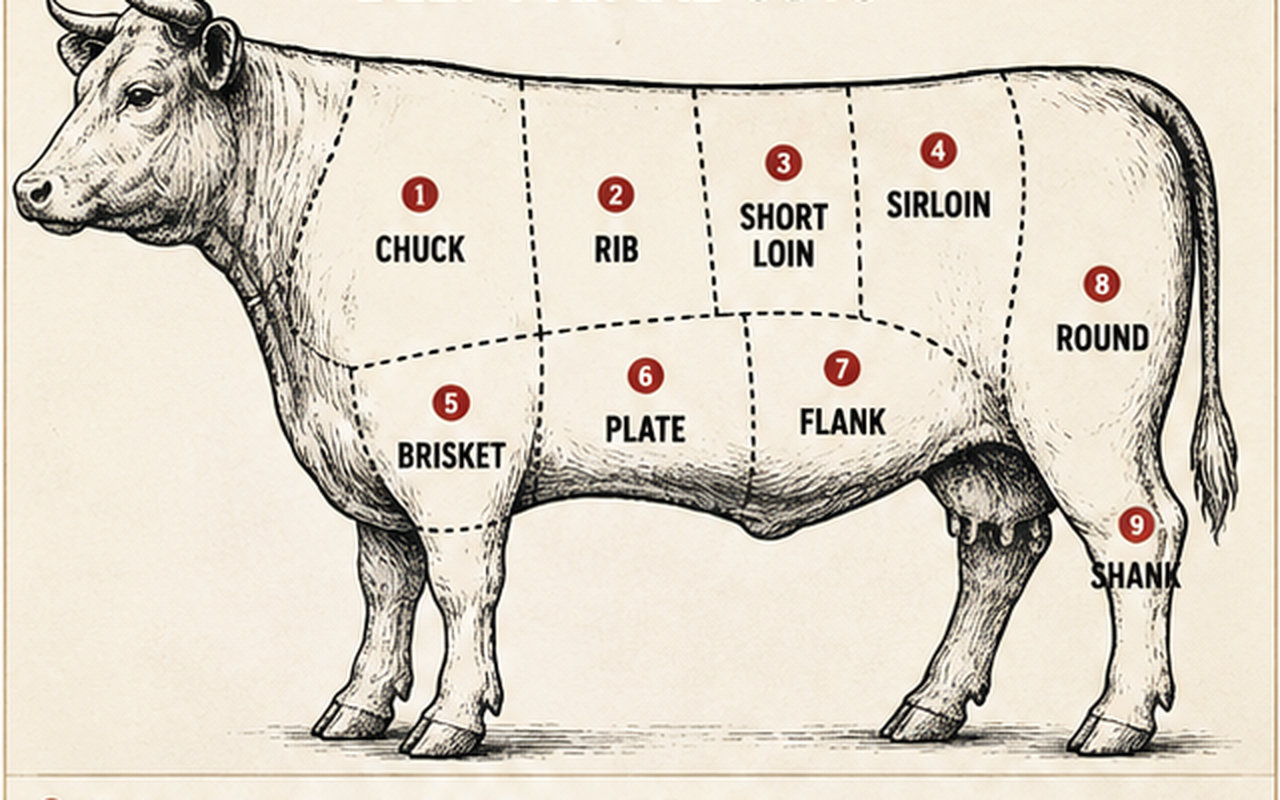
Tap a region on the diagram, or use the list below.
Nine regions, matching the Beef Board retail chart convention where the loin is shown as short loin and sirloin. USDA FSIS names four major primals (chuck, loin, rib, round); brisket, plate, flank and shank are treated as primals by the Beef Board. Short loin and sirloin are both sub-primals of the FSIS loin.
Pick a region
- 01
Chuck
The shoulder. Hard-working, richly flavoured, full of connective tissue that rewards low and slow.
Tenderness 2/5. Richness 4/5. Smoke.
- 02
Rib
The middle of the back. Well marbled, tender, home of the ribeye and the prime rib roast.
Tenderness 5/5. Richness 5/5. Grill.
- 03
Short loin
The front of the loin. Strip steak, T-bone, porterhouse and the tenderloin's thick end. Tender, leaner than rib.
Tenderness 5/5. Richness 3/5. Grill.
- 04
Sirloin
The back of the loin. Leaner steaks with big beef flavour, and the tri-tip.
Tenderness 4/5. Richness 3/5. Grill.
- 05
Brisket
The breast. The Beef Board calls it tougher because it is used for movement, and ideal for low and slow. The centre of Central Texas barbecue.
Tenderness 1/5. Richness 5/5. Smoke.
- 06
Plate
The belly behind the brisket. Plate short ribs, skirt steak and hanger. Rich, fatty, and two very different cooking personalities.
Tenderness 2/5. Richness 5/5. Smoke (short ribs).
- 07
Flank
Lean, boneless, intensely beefy. The Beef Board's words: best marinated and grilled, or sliced thin.
Tenderness 2/5. Richness 3/5. Grill.
- 08
Round
The hind leg. Lean and, in FSIS's words, less tender. Roasts and steaks that want moist heat or a thin slice.
Tenderness 2/5. Richness 2/5. Roast.
- 09
Shank
The leg below the knee. Tough, gelatinous, full of flavour. Braise it or smoke it into a shredded 'Thor's hammer'.
Tenderness 1/5. Richness 4/5. Braise.
Names confusing? brisket flat vs point.
Safe first. Then done.
145 F (62.8 C), then rest at least 3 minutes before carving or consuming
Steaks, chops and roasts (whole muscle). Food thermometer in the thickest part, away from bone, fat and gristle, read before removing from the heat source. This is a food safety floor, not a preference. Where any other number on this page is lower, this one governs.
Source: USDA Food Safety and Inspection Service, Safe Minimum Internal Temperature Chart, page updated 2025-04-14, read 2026-09-02.
160 F (71.1 C)
Ground meat, burgers, sausage mixtures, meat loaf, and organ or variety meats. Food thermometer through the side of a patty to the centre. This is a food safety floor, not a preference. Where any other number on this page is lower, this one governs.
Source: USDA Food Safety and Inspection Service, Safe Minimum Internal Temperature Chart, page updated 2025-04-14, read 2026-09-02.
beef industry
Steaks and roasts, final temperature after rest. Culinary preference, as published by the industry body cited below.
| Doneness | Internal temp | Vs. USDA 145 F |
|---|---|---|
| Medium rare | 145 F, rest at least 3 minutes | At or above the minimum. |
| Medium | 160 F | At or above the minimum. |
| Well done | 170 F | At or above the minimum. |
Carryover: Roasts rise 5 to 15 F after leaving the heat; allow 15 to 20 minutes standing time.
beef convention
Steaks, steakhouse and pitmaster convention, pull temperatures. Culinary preference, barbecue convention.
| Doneness | Internal temp | Vs. USDA 145 F |
|---|---|---|
| Rare | 120 to 125 F | Below the minimum. Preference, not safety. |
| Medium rare | 130 to 135 F | Below the minimum. Preference, not safety. |
| Medium | 140 to 145 F | Below the minimum. Preference, not safety. |
| Medium well | 150 to 155 F | At or above the minimum. |
| Well done | 160+ F | At or above the minimum. |
Carryover: Craft convention: 5 to 10 F rise on a steak during a 5 to 10 minute rest.
Rare, medium-rare and medium figures are culinary preference ranges that fall below the USDA FSIS safe minimum of 145 F with a 3 minute rest. USDA does not consider them safe. Where the two differ, the USDA minimum governs.
Collagen cuts do not use a doneness scale. They cook to a tenderness window, shown on each cut page and on the beef temperature page.
What to burn under beef
| Wood | Strength | Character |
|---|---|---|
| Oak | medium | Balanced, clean, dependable. The all-purpose smoke and the Central Texas standard (post oak). |
| Hickory | strong | Bold, savoury, bacon-like. The classic pork and rib smoke; heavy-handed on poultry. |
| Mesquite | strong | Intense, earthy, fast-burning. Best for hot-and-fast beef; turns harsh over a long cook. |
| Pecan | medium | Nutty, warm, slightly sweet. A softer relative of hickory. |
| Cherry | mild | Fruity, mild, and it colours the meat a deep mahogany. Pairs with almost everything. |
The nine primals on one card
Tenderness, richness, best method, finish and slice direction for each region, with the USDA reminder in the corner. The numbers on this card match the records on this page.
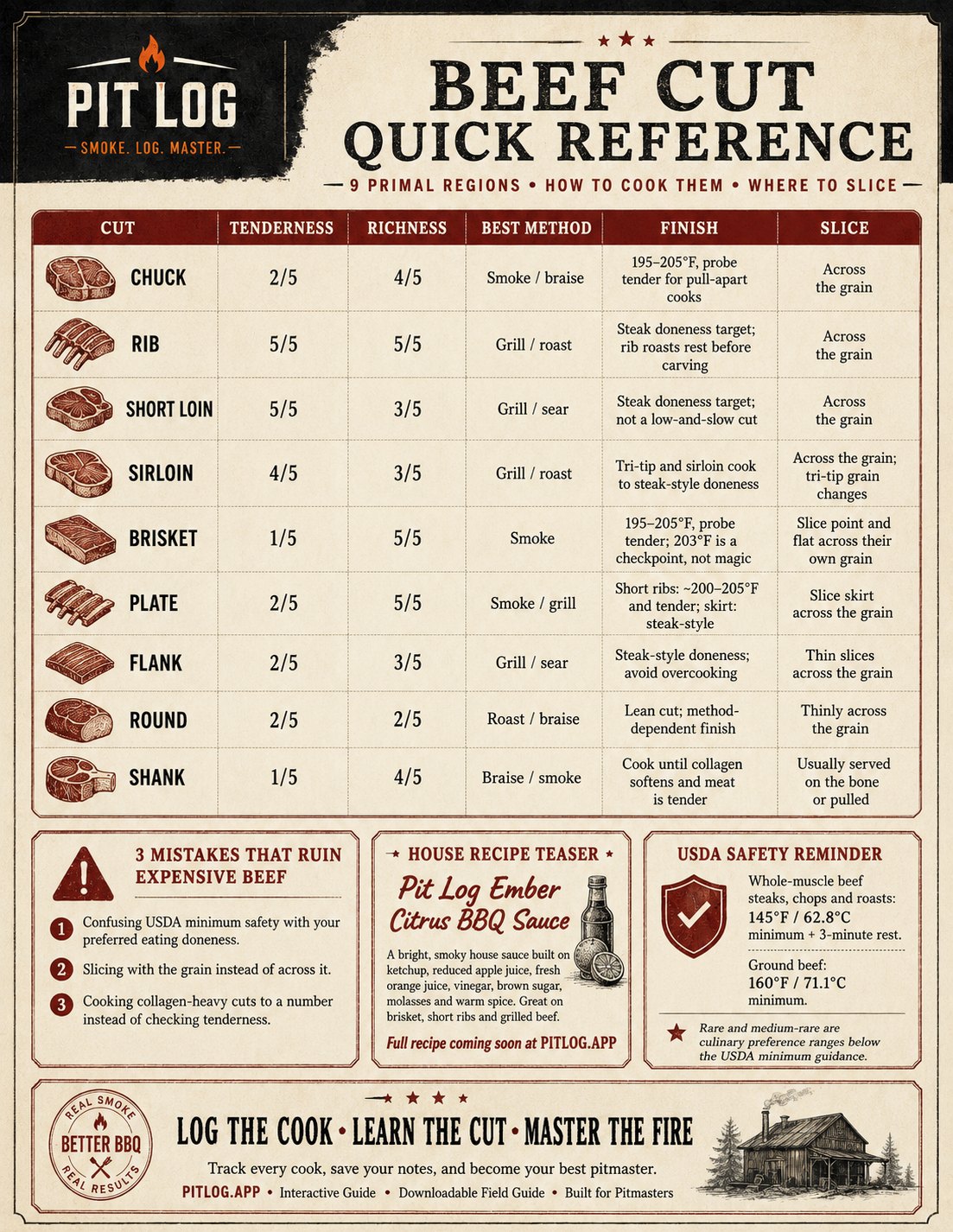
Poster print coming once the print master is ready. The sauce it names is live in the test kitchen.
Beef recipes
- Pit Log Central Texas Brisket (test v1)
- Santa Maria-Inspired Tri-Tip (test v1)