Pork primal cuts.
Pork is classed as red meat. Since 2011 USDA's whole-muscle minimum is 145 F with a 3 minute rest, and safely cooked pork can still be pink. The shoulder is the most forgiving barbecue cut there is.
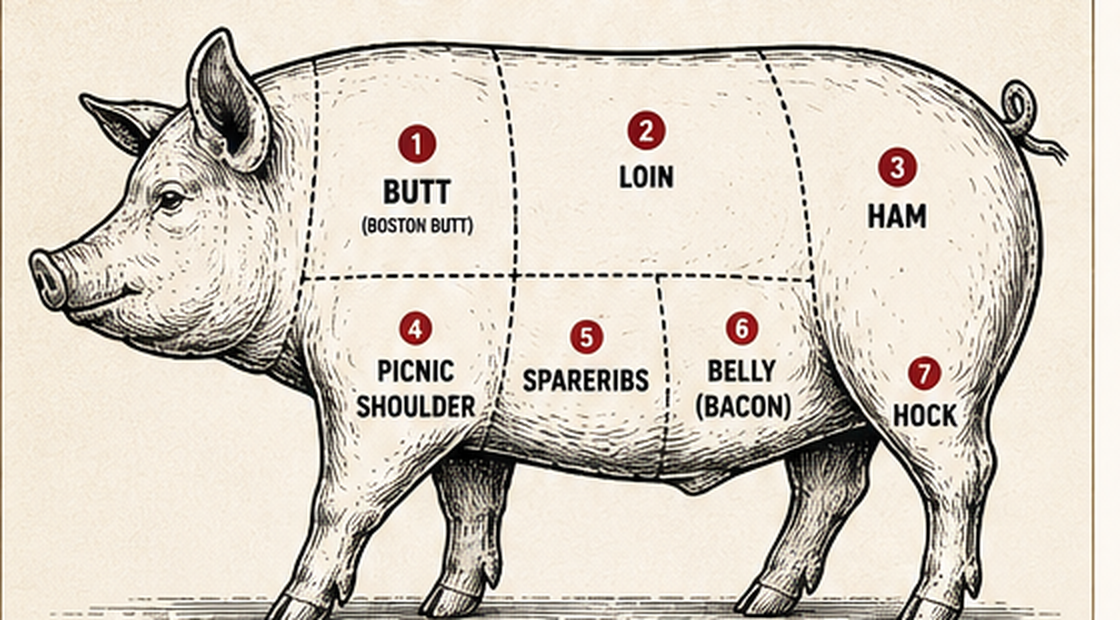
Tap a region on the diagram, or use the list below.
Seven regions, matching master pork-A. USDA FSIS names four primals: shoulder (butt + picnic + hock), loin, side (spareribs + belly/bacon) and leg (ham). Master pork-B also shows the jowl; it is recorded as a retail cut under the shoulder rather than a region.
Pick a region
- 01
Butt (Boston butt)
The upper shoulder. Well marbled, forgiving, the pulled-pork cut.
Tenderness 2/5. Richness 4/5. Smoke.
- 02
Loin
The back. Lean and tender: chops, loin roast, tenderloin, baby back ribs.
Tenderness 4/5. Richness 2/5. Grill.
- 03
Ham (leg)
The hind leg. Fresh ham roasts; cured and smoked ham is the holiday cut.
Tenderness 3/5. Richness 2/5. Roast.
- 04
Picnic shoulder
The lower shoulder and upper foreleg. More connective tissue and skin than the butt; cheaper; smokes the same way.
Tenderness 2/5. Richness 3/5. Smoke.
- 05
Spareribs
The rib cage from the belly side. Meatier and fattier than baby backs; St. Louis cut is a trimmed sparerib.
Tenderness 2/5. Richness 4/5. Smoke.
- 06
Belly
The underside. Bacon uncured; burnt ends smoked; the richest cut on the animal.
Tenderness 3/5. Richness 5/5. Smoke.
- 07
Hock
The ankle. Tough, gelatinous, mostly skin, bone and collagen. Flavour for beans, greens and stock; smoked hocks are the classic.
Tenderness 1/5. Richness 4/5. Simmer.
Names confusing? pork butt vs pork shoulder.
Safe first. Then done.
145 F (62.8 C), then rest at least 3 minutes before carving or consuming
Steaks, chops and roasts (whole muscle). Food thermometer in the thickest part, away from bone, fat and gristle, read before removing from the heat source. This is a food safety floor, not a preference. Where any other number on this page is lower, this one governs.
Source: USDA Food Safety and Inspection Service, Safe Minimum Internal Temperature Chart, page updated 2025-04-14, read 2026-09-02.
160 F (71.1 C)
Ground meat, burgers, sausage mixtures, meat loaf, and organ or variety meats. Food thermometer through the side of a patty to the centre. This is a food safety floor, not a preference. Where any other number on this page is lower, this one governs.
Source: USDA Food Safety and Inspection Service, Safe Minimum Internal Temperature Chart, page updated 2025-04-14, read 2026-09-02.
pork chops roasts
Chops, loin, tenderloin and whole-muscle roasts. Culinary preference, as published by the industry body cited below.
| Doneness | Internal temp | Vs. USDA 145 F |
|---|---|---|
| Medium (USDA minimum) | 145 F, rest at least 3 minutes | At or above the minimum. |
| Medium well | 150 to 155 F | At or above the minimum. |
| Well done | 160+ F | At or above the minimum. |
Carryover: National Pork Board: pull a smoked loin at 140 F and rest 10 minutes in a warm place until it reaches 145 F. Chops: 145 F then a 3 minute rest.
Collagen cuts do not use a doneness scale. They cook to a tenderness window, shown on each cut page and on the pork temperature page.
What to burn under pork
| Wood | Strength | Character |
|---|---|---|
| Hickory | strong | Bold, savoury, bacon-like. The classic pork and rib smoke; heavy-handed on poultry. |
| Apple | mild | Sweet, fruity, gentle. Builds slowly; forgiving on poultry and pork. |
| Cherry | mild | Fruity, mild, and it colours the meat a deep mahogany. Pairs with almost everything. |
| Pecan | medium | Nutty, warm, slightly sweet. A softer relative of hickory. |
Recipes
The pork house recipes are in the test kitchen. See what is live on the recipes page.