Lamb primal cuts.
Lamb is a sheep under about a year old; older animals are mutton. Rack and loin are tender dry-heat cuts. Shoulder, shank and breast are collagen cuts that reward low and slow.
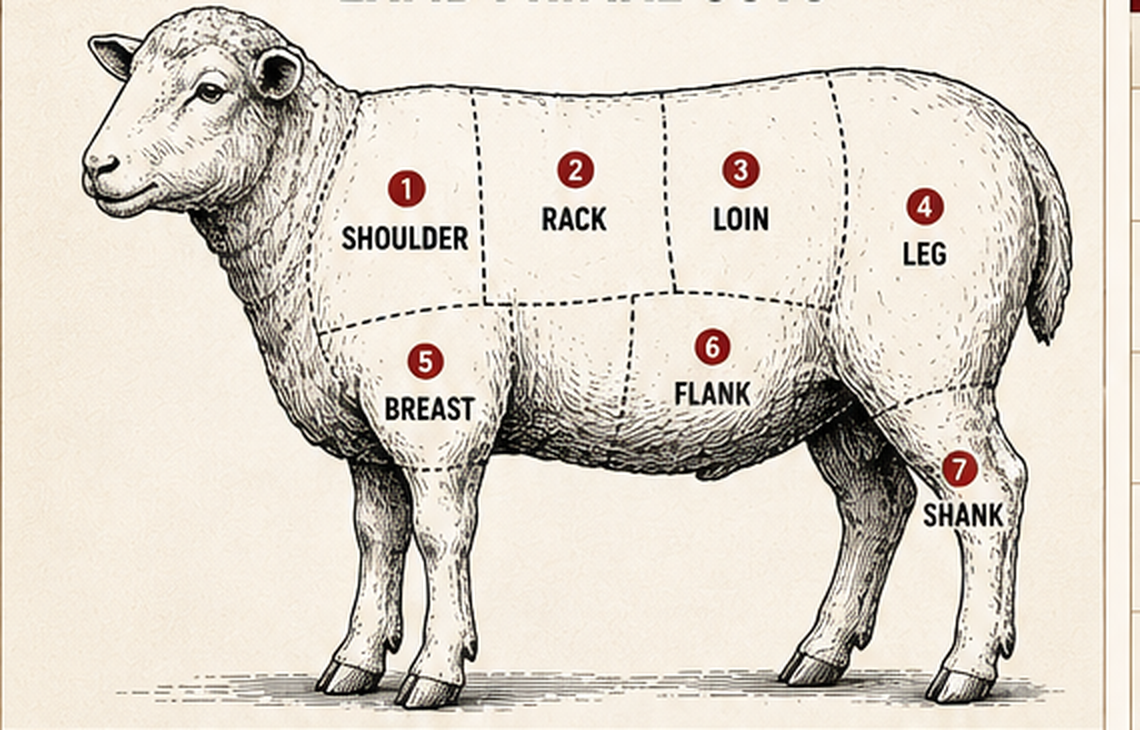
Tap a region on the diagram, or use the list below.
Seven regions, matching the master. USDA FSIS names five primals: shoulder, rack, shank/breast, loin, leg. Flank is not an FSIS primal; it is part of the breast/flank plate and is kept as a region because the product's diagram and the retail 'lamb flank' cut both exist.
Pick a region
- 01
Shoulder
Flavourful, fattier than leg, full of connective tissue. The American Lamb Board: requires low and slow.
Tenderness 2/5. Richness 4/5. Smoke.
- 02
Rack
The rib primal. Eight chops per rack (Lamb Board), nine ribs in the whole primal (FSIS). Tender, quick, the showpiece.
Tenderness 5/5. Richness 4/5. Roast.
- 03
Loin
Between rack and leg. Loin chops with the T-shaped bone; lean and tender.
Tenderness 5/5. Richness 3/5. Grill.
- 04
Leg
The hind leg. Lean, large, the classic roast; butterflied it grills; sirloin chops come off the top.
Tenderness 3/5. Richness 2/5. Roast.
- 05
Breast
The belly and lower ribs. Fatty, cheap, the source of lamb ribs and riblets. Braise or smoke low.
Tenderness 2/5. Richness 5/5. Smoke.
- 06
Flank
The thin belly muscle behind the breast. Lean, coarse-grained; marinate, grill fast, slice thin.
Tenderness 2/5. Richness 3/5. Grill.
- 07
Shank
Fore and hind shanks. Collagen and bone; the Lamb Board: practically melt off the bone when slow cooked.
Tenderness 1/5. Richness 3/5. Braise.
Safe first. Then done.
145 F (62.8 C), then rest at least 3 minutes before carving or consuming
Steaks, chops and roasts (whole muscle). Food thermometer in the thickest part, away from bone, fat and gristle, read before removing from the heat source. This is a food safety floor, not a preference. Where any other number on this page is lower, this one governs.
Source: USDA Food Safety and Inspection Service, Safe Minimum Internal Temperature Chart, page updated 2025-04-14, read 2026-09-02.
160 F (71.1 C)
Ground meat, burgers, sausage mixtures, meat loaf, and organ or variety meats. Food thermometer through the side of a patty to the centre. This is a food safety floor, not a preference. Where any other number on this page is lower, this one governs.
Source: USDA Food Safety and Inspection Service, Safe Minimum Internal Temperature Chart, page updated 2025-04-14, read 2026-09-02.
lamb industry
Chops, rack, leg and roasts. Pull temperature and final temperature after rest. Culinary preference, as published by the industry body cited below.
| Doneness | Pull at | Internal temp | Vs. USDA 145 F |
|---|---|---|---|
| Medium rare | 135 F | 145 F, rest 3 minutes | At or above the minimum. |
| Medium | 150 F | 160 F | At or above the minimum. |
| Well | 160 F | 170 F | At or above the minimum. |
Carryover: American Lamb Board: pull 10 F below the target because the internal temperature keeps rising.
lamb goat convention
Chops and rack, restaurant convention, pull temperatures. Culinary preference, barbecue convention.
| Doneness | Internal temp | Vs. USDA 145 F |
|---|---|---|
| Rare | 125 to 130 F | Below the minimum. Preference, not safety. |
| Medium rare | 130 to 135 F | Below the minimum. Preference, not safety. |
| Medium | 135 to 145 F | Below the minimum. Preference, not safety. |
| Medium well | 145 to 155 F | At or above the minimum. |
| Well done | 160+ F | At or above the minimum. |
Carryover: 5 to 10 F on a rack or chop.
Rare, medium-rare and medium figures are culinary preference ranges that fall below the USDA FSIS safe minimum of 145 F with a 3 minute rest. USDA does not consider them safe. Where the two differ, the USDA minimum governs.
Collagen cuts do not use a doneness scale. They cook to a tenderness window, shown on each cut page and on the lamb temperature page.
What to burn under lamb
| Wood | Strength | Character |
|---|---|---|
| Oak | medium | Balanced, clean, dependable. The all-purpose smoke and the Central Texas standard (post oak). |
| Pecan | medium | Nutty, warm, slightly sweet. A softer relative of hickory. |
| Hickory | strong | Bold, savoury, bacon-like. The classic pork and rib smoke; heavy-handed on poultry. |
| Cherry | mild | Fruity, mild, and it colours the meat a deep mahogany. Pairs with almost everything. |